Showing posts with label Earth Science. Show all posts

Tuesday, May 13, 2014

Mapping the Solar System

I recently encountered this activity for the first time, on the McDonald Observatory website.  I've since found the same activity on numerous other sites.  I don't know where it came from first, but I'll give credit to the place where I first saw it.

Anyway... it's a super simple way for students to map the solar system and get a feel for how much distance is between the planets.  In short, it's brilliant!

Each student will need a sentence strip or a length of adding machine/calculator paper.


Hold the paper vertically and label (in small letters) one end of the strip "Sun" and the other end "Pluto".

At this point, you can have students fill in the planets with their best guesses as to their placement.  Or you can just make the accurate map.  It's up to you and your situation.

To make the map:
Fold Pluto to the Sun.  Label Uranus on the crease.
Fold Pluto to Uranus.  Label Neptune on the crease.

 Fold the Sun to Uranus.  Label Saturn on the crease.
Fold the Sun to Saturn.  Label Jupiter on the crease.
Fold the Sun to Jupiter.  You can label the crease Asteroid Belt or leave this space blank.

Fold the Sun to the Asteroid Belt.  Label Mars on the crease.
Fold the Sun to Mars. Label Venus on the crease.

Label the space between the Sun and Venus, Mercury.  (You could fold the Sun to Venus and label the crease, but the space gets a little tight to make more folds at this point).

Label the space between Venus and Mars, Earth.

That's it!  You've completed your map!  And it's incredibly accurate for such a simple model.

I'm thinking it might be fun to convert distances to some other notable bodies in the cosmos to this scale and lay out the sentence strips to show kids the vast amount of space in space.  I'll let you know what I come up with!

Tuesday, September 17, 2013

Weathering: Plant Roots

 
Plants, specifically plant roots, are one source of weathering.  Cracks in driveways and sidewalks often provide evidence of this, but it's simple to watch it take place within your classroom. 

You'll need some Plaster of Paris*, seeds** and a small disposable cup or cupcake paper.

Mix the plaster according to the package instructions (usually 2 parts plaster to 1 part water).  Pour the plaster into your vessel. 

Poke two or three seeds into the plaster.  Place in a spot where it won't be disturbed while the plaster sets and the seeds germinate (there's enough moisture in the plaster for the seeds to begin germinating, no need to add anything). 

Within a day my seeds had swollen and begun to germinate.  The force the seed exerted was enough to crack the plaster. 

Now think about what happens in a driveway or sidewalk... a crack forms in the surface, seeds blow or fall into the crack, a bit of rain falls and the seeds begin to germinate.  The force of the seed germinating and the roots taking hold forces the more cracking.  Now there's a larger crack into which more seeds can gather and cause further cracking.  If nothing is done to curb the problem, eventually the sidewalk or driveway will be dessimated. 

*FYI Plaster of Paris does have a limited shelf life.  If it gets too old, it won't set up properly and you'll have a crumbly mess.

**I've mentioned it before, but dried beans (like you'd use to make soup or baked beans) will germinate.  They're cheaper to buy in a large quantity than garden seeds and they can be found easily year-round.

Wednesday, August 7, 2013

Cookie Fossil Dig

IMG_3631.jpg
Can your students work with the precision and patience needed by a paleontologist on a fossil dig?

IMG_2705.jpg
Provide each student with a chocolate chip cookie, a toothpick and a small paintbrush.  See who can remove the most unscathed chocolate chips without breaking the cookie!

IMG_5742.jpg
You might want to have your students try a few different types of cookies - are the chips easier to remove from crisp cookies or soft, chewy cookies?

I did this simple, paleontologist cookie dig with students at our library during a summer program, which was perfect for the age group I was working with (3 - 10).  However, I've also done cookie mining with middle school students.  Women in Mining provides a fantastic activity that includes a financial aspect (students are given a budget and have to purchase their cookie, mining tools, mining time and reclamation costs) in addition to precision.  I've mentioned it before, but it's worth repeating... take some time to check out the other activities on the Women in Mining website - they're really well done!

Wednesday, July 10, 2013

Erosion & Run-Off: What affect does vegetation have?

 This is a really simple demonstration, but it does require some planning ahead (not always my strong suit... )

You'll need two shallow pans or boxes.  Fill each pan with dirt.  Sprinkle grass seed on one of the pans of dirt.  Keep the soil moist as the grass seed germinates and grows.  (You don't need to do anything with the other pan of dirt right now).

Once you have a nice crop of grass in the one pan, take both pans outside.  Prop up one end of each pan using bricks (or something else that will raise it a few inches).

Begin to spray both pans with a hose or spray bottles of water.  You can spray in any manner you'd like, just try to get both pans equally.

While you're spraying, observe what happens to both the soil and the water in each situation. 

When you've finished, discuss the impact of vegetation on soil erosion and/or water run-off. 

Wednesday, June 12, 2013

The Expanding Universe: Balloon Model

 On a flat, not-yet-inflated balloon, mark a series of points using a permanent marker.  You may wish to make some of the points closer together and others farther apart. 

These marks represent parts components of the universe.  You may wish to have students measure the distance between points to make it more quantitative, of you may wish to just keep it a visual activity. 

 As you begin to inflate the balloon, the points mover farther and farther away from each other.  The universe is expanding and distance between points is growing. 


Wednesday, February 15, 2012

Solar System: Pictorial Comparison

Originally posted on February 2, 2010

I LOVE these pictures. I first learned of them a few years ago and promptly printed and laminated a set for my classroom. I was reminded of them recently when I received them as an email attachment.

I think the art is beautiful and I can just stare at them-my mind spinning, trying to comprehend the size of the universe, all the while.

I don't know the source for these pictures. If someone out there does, please let me know and I will gladly add it.


Monday, December 12, 2011

Tsunami!: Tsunami Demonstration


Tsunami! is the story of

If you're feeling ambitious, you can make a very cool tsunami demonstrator following the directions found here

If you're not up for such a task, you can make simpler models using 2 liter soda bottles.  While this simpler model probably doesn't have the same impact as the fancier versions, it does have the added bonus of allowing students to take part in its construction and manipulation.

Fill the 2 liter bottle with about 2 inches of gravel.  (I used sand because I had it on hand, but gravel works MUCH better).

Then pour about 250 ml of water (about 1 cup) into the bottle.  Cap it tightly.

Gently lower the bottle to its side, so the gravel forms a slope at the end of the bottle (you'll see that the sand doesn't work so well at this point, in the picture below).  The gravel slope represents the sea floor and then the beach.  The water represents the ocean.

Use the palm of your hand to smack the bottle cap (i.e. the end of the bottle opposite the gravel slope), to generate a wave.

Observe the wave formation and the way it crashes upon the gravel.  Also note the way the water sloshes around on the gravel following its initial crash - the danger of a tsunami extends beyond the initial landfall. 


Tuesday, November 29, 2011

Oceans: Increasing Pressure with Depth

Students don't always understand that the deeper you go under water, the greater the pressure.  This immense pressure is one of the reasons why so much of the ocean floor is still unexplored. 

Try out this demonstration to help your students visualize the pressure increasing as they travel deeper.

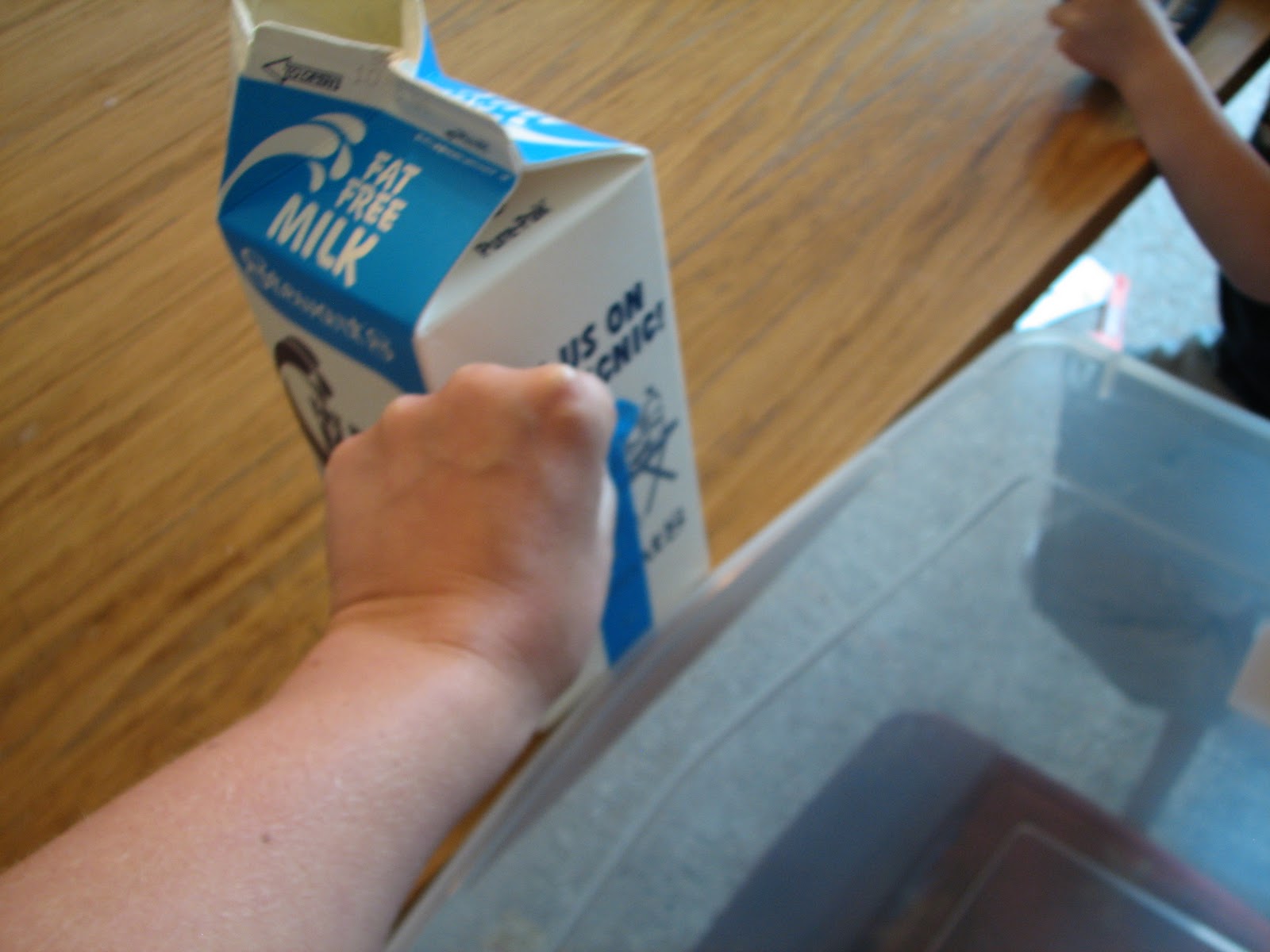
Begin with an empty carton from a half-gallon of milk or OJ.  (A bottle would work too, but it's much more difficult to make the holes). 

You'll also need some masking tape, a large tub in which to collect water and a poking device - I found a skewer worked well for me.

Lay the carton on its side on the table and make a hole near the bottom of the carton.

Make a second hole 1 - 2" above the first hole and a third hole 1 - 2" above the second hole.

Run a strip of masking tape down the carton, covering all three holes.

Fill the carton with water and set it on the table, with a tub to catch the water when it spills out of the holes. 

When you're ready, remove the tape and observe the water flowing out of each hole.

The water coming out of the bottom hole is under the greatest pressure (it has the most water/weight on top of it) and it is pushed out of the carton with much greater force - look how far it shoots out.

The water coming out of the top hole is under little pressure (there's not much pushing on it), so it sort of dribbles out.

Tuesday, November 22, 2011

Atmosphere: Play Doh model

Begin with 5 (or 4, if you take your photographs without going back and looking at your own directions... sheesh) equal sized balls of Play Doh.  Color is unimportant in this model. 

Place one ball on a piece of wax paper, this is the troposphere. 

Place a heavy book on top of the Play Doh.

Place another ball of Play Doh on top of the book, this is the stratosphere.

Place another heavy book on top of the Play Doh. 

Continue alternating balls of Play Doh and heavy books until you've accounted for the 5 layers of the atmosphere. 

Then unstack the books.  You'll find that as you move closer to the Earth (the bottom of the stack), the layers become thinner.

Tuesday, November 15, 2011

Plate Tectonics: The Break Up of Pangea Flipbook

Have your students watch Pangea break up, while making a flip book.

Professor Braile (Purdue University) has done the hard work - you simply need to copy the maps onto cardstock (for the best results) for your students.  They color and assemble the maps in the proper order. 

Tuesday, November 8, 2011

Weathering: By Falling Water

One of the ways in which rocks are weathered (broken down into smaller pieces) is by falling water.

Place a bar of soap on a sponge.  Set the sponge in a sink under a faucet.

Use the faucet as usual for a day, letting the water hit the soap and observe the soap at the end of the day.  Or you could let the faucet drip on the soap for the duration of the class period.


The falling water knocks particles of soap free.  Similarly, rocks at the bottom of waterfalls (or in other locations where water falls over them) are weathered by the falling water over time.  Of course, this process takes a very long time since rocks are lots harder than soap!

Tuesday, November 1, 2011

Erosion: A Flowing River

This is a good one to do outside, if you can swing it.  If not, it can be done inside, you'll just need to work harder to contain the water.

Materials:
--Paper cup
--Drinking straw
--Clay
-- Cookie sheet
--Loose soil or sand
--Jug filled with water (or other water source)

Prep Work:
Poke a hole in the side of the paper cup, near the bottom. 
Cut the straw in half and place one half in the hole.
Seal the hole, around the straw, with the clay.

For the Demonstration:
Lay the cookie sheet upside down on the ground and raise one end about 2 inches, using scrap wood, a brick, a pile of soil, whatever's convenient. 

Cover the cookie sheet with a thin layer of soil or sand. Place the cup at the raised end of the cookie sheet.

Hold your finger over the straw as you fill the cup with water. Remove your finger and watch the way path of the water.

Raise the end of the cookie sheet to about 6 inches, recover the sheet with soil and repeat.

What differences did the slope make in the erosion?

Cover the cookie sheet with a layer of soil again.  This time, place a small rock  in the soil in front of the straw. 

Fill the cup and watch what happens to the water as it encounters the rock.  You can place additional rocks along the way to change the direction of the river.