Showing posts with label Nursery Rhyme Science. Show all posts

Tuesday, January 7, 2014

Nursery Rhyme Science: Hot Cross Buns

Hot cross buns!
Hot cross buns!
One a penny, two a penny,
Hot cross buns!
Give them to your daughters.
Give them to your sons.
One a penny, two a penny,
Hot cross buns!

Activity 1: Rising Up
Hot cross buns are a type of yeast bread.  Yeast is a living organism (a fungus to be exact), that is used to make bread dough rise.  If you didn't use yeast, your bread would be small, flat and hard as a rock.

When you open a package of yeast and pour some out, it doesn't look like much.  It certainly doesn't seem to do anything.  The yeast is in a dormant state - it's still alive but it's not actually doing anything; kind of like being asleep.

To get the yeast going you'll need to do two things:
1 - warm up the yeast so that it "wakes" up
2 - give the yeast something to eat

Put the yeast in a flask or small-neck bottle.  Add some warm water (to wake up the yeast) and some sugar (to feed the yeast).

Stretch a balloon over the top of the flask/bottle and allow it to sit somewhere where everyone can keep an eye on it for the next hour or two.

As time passes, you'll notice the balloon filling up.  It's catching the carbon dioxide the yeast is releasing.  When you make bread, the yeast does the same thing, creating small pockets of air within the bread!


Activity 2: Does "Hot" Always Feel the Same?
 Temperature can be a funny thing.... A 60 degree day in March feels fabulously warm and wonderful.  That same temperature, in the middle of July, feels frigid.  The temperature is the same, but the way in which it feels can vary depending upon our perspective.

Here's a way you can actually feel that principle at work in a matter of minutes.

You'll need three bowls:
--Fill one bowl with water and allow it to sit for about 5 minutes (or more) to reach room temperature.
--Fill the next bowl with water and add several ice cubes.  Stir.
--Fill the final bowl with warm tap water.  Aim for something that just feels warm on your wrist - you don't water so hot that it'll hurt you.

Arrange the bowls on the table so that the room temperature water is in the middle and the hot and cold water are on either side of it.


Place one hand in the warm water and the other hand in the cold water.  Leave them there for about 20 seconds. 

Remove your hands from the bowls and place them both in the middle (room temperature) bowl.  How do they feel?

Even though they are now in the same water, the hand that was in the cold water feels warm and the hand that had been in the warm water feels cold.

The explanation....
You placed your hand in warm water.  The energy (heat) moved from the water, which was hotter than your hand, to your hand, making it feel warm.  Then you placed it in water that was colder than your (now warmed) hand.  The energy (heat) left your hand and flowed into the water, leaving your hand feeling cold.

You placed your other hand in cold water.  The energy (heat) moved from your hand into the cold water.  When you placed that hand, with a reduced amount of heat energy, in the room temperature water, energy (heat) flowed from that water to you hand because there was more energy in the water than your hand.

Tuesday, December 17, 2013

Nursery Rhyme Science: Humpty Dumpty


Humpty Dumpty
Sat on a wall.
Humpty Dumpty
Had a great fall.

All the King's horses
And all the King's men
Couldn't put Humpty
Together again.

Activity 1: Safe From Any Height
Host a mini-egg drop contest to see what could be done to protect Humpty Dumpty.

Before students get to work, demonstrate what happened to Humpty Dumpty in the rhyme.  Push a raw egg off a desk (onto a drop cloth or something else that will make clean-up easier) and observe. 

Put students into small groups to work and challenge them to build a contraption to protect Humpty Dumpty from any subsequent falls.  With preschool or kindergarten students, I would provide each group with a cup or other container as a starting point for their construction.  I wouldn't give anything to older students - let them come up with the ideas on their own. 

Provide an assortment of additional materials for students to work with:

  • yarn
  • fabric
  • packing peanuts
  • sponges
  • cotton balls
  • newspaper
  • balloons
  • straws
  • popsicle sticks
  • cotton batting
  • anything else you can think of


After students have completed their contraptions and placed an egg inside, push each one off the same desk and see if Humpty Dumpty fares any better.

It's possible that some eggs may still break, which is the perfect time to ask the students how they would change their contraption design to make it even better. 

Tuesday, December 10, 2013

Nursery Rhyme Science: Little Jack Horner

Little Jack Horner sat in a corner,
Eating a Christmas pie.
He put in his thumb,
And pulled out a plum,
And said, “What a good boy am I!”

Activity 1: Identify the parts of a plum
It's very possible that your kindergarten students aren't familiar with plums.  Pick one up at the store and identify the parts with them: the skin, the flesh and the pit.


Activity 2: Compare and Contrast
Compare the plum to another fruit that students, such as an apple or an orange.  What do the fruits have in common and what's different about them.


Activity 3: Plant the pit
Will the pit grow?  Remove the pit from the plum and plant it in a cup with some dirt.  Give it a little water and see what happens.

Tuesday, November 12, 2013

Nursery Rhyme Science: Hickory Dickory Dock

Hickory Dickory Dock,
The mouse ran up the clock.
The clock struck one,
The mouse ran down.
Hickory Dickory Dock.

Activity 1: The Chiming Clock
Can you make a coat hanger sound like a loud, chiming clock?

This is a simple demonstration that helps make the point that sound needs something to travel through and that air is not a very efficient material for that purpose.

You only need a wire coat hanger and a long length of string.


Tie the string onto the hanger, so that the hanger hangs from the middle of the string.

Swing the hanger from the string so that it bumps into something (a table, chair, wall, etc.) and take note of the sound it makes.  It's kind of a short, clang-y sound.  Nothing very dramatic or melodic about it.

Now, wrap one end of the string around one of your index fingers and the other end around the other index finger.

Place your fingers in your ears (gently, there's no need to jam them in).

Swing the hanger so that bumps into something once again and take note of the sound it makes.  Louder and more like a gong or large bell ringing.

In the first trial, the sound made when the hanger hit the object had to travel through the air to reach your ear drum.  A lot of the sound was lost on the way to your ear.  In the second trial, the sound vibrations travel from the hanger through the string and your fingers to your ear.  Much less sound energy is lost in route and it makes an audible difference. 

Tuesday, November 5, 2013

Nursery Rhyme Science: Row, Row, Row your boat

Row, row, row your boat
Gently down the stream.
Merrily, merrily, merrily, merrily,
Life is but a dream.

Activity 1: Soap Boats
Show your students two bars of soap - one bar of Ivory soap and a bar of any other brand of soap.  Ask them which bar they think would make the better boat and why.  

Put the bars of soap in a pan of water (a clear tub is good, so everyone can see easily) and observe.  

After seeing what happened (Ivory soap floats, all other brands sink), which soap do they think would make the better boat now? 

Ivory whips more air into their soap than other brands, so it is less dense than water and will float.  
You can even make a little mast and sail with a coffee stirrer and piece of fun foam :) 
(My boys came home from preschool with an Ivory soap boat each Columbus Day!)

Activity 2: Boat Races

 
Cut out a boat shape from an index card or piece of thin cardboard.

Cut a small notch out of the back of the boat.

Float the boat in a tub of water.  What happens?  Not much!

Now, place a small sliver of soap in the notch and watch.  What happens?  The boat moves across the tub!


Why?
Without soap, the water pulls on the boat from all directions, resulting in little to no movement.  When the soap is added, it reduces the pull of the water at the back of the boat.  The pull at the front of the boat remains  strong and you see movement. 

Students can experiment with boat shape to find the fastest (and straightest) racer!

Because the soap reduces the water's surface tension, the water in the tub will need to be dumped out and replaced often.

Tuesday, October 29, 2013

Nursery Rhyme Science: Three Men in a Tub

Rub-a-dub-dub!
Three men in a tub,
And who do you think were there?
The butcher, the baker, the candlestick maker,
And all of them gone to the fair!

Activity 1: How many men can your tub hold?
Provide each child with a piece of aluminum foil (the size isn't terribly important, just try to keep the pieces about the same size).

Each child will shape the foil into some sort of tub or boat.


Place the tubs/boats in a tub of water (if they don't float now, do some tinkering to get them to float).  Then begin adding penny passengers, one at a time.


After the boats sink, you can talk about what worked well and what didn't work so well.  If you have the time available, you can provide students with another piece of foil to make a new boat.  Can they use what they learned to make a boat that holds more pennies than the first? 

Tuesday, October 22, 2013

Nursery Rhyme Science: Simple Simon

Simple Simon met a pieman
Going to the fair;
Said Simple Simon to the pieman,
“Let me taste your ware.”

Said the pieman to Simple Simon,
“Show me first your penny;”
Said Simple Simon to the pieman,
“Sir, I haven’t any.”

Simple Simon didn't have a penny to buy a pie, but if you have a penny, you can do some fun science experiments...

Activity 1: Drops on a Penny
How many drops of water do you think a penny can hold? Allow each child to make a guess.

Take a few minutes to practice using an eye dropper, so everyone can squeeze out a drop at a time.  (This activity provides great fine motor practice!)

Then place a penny on a paper towel.  Provide each student with a dropper and a small cup of water.  Have students place drops of water on the penny, counting each drop, until the water spills over the side of the penny.

 
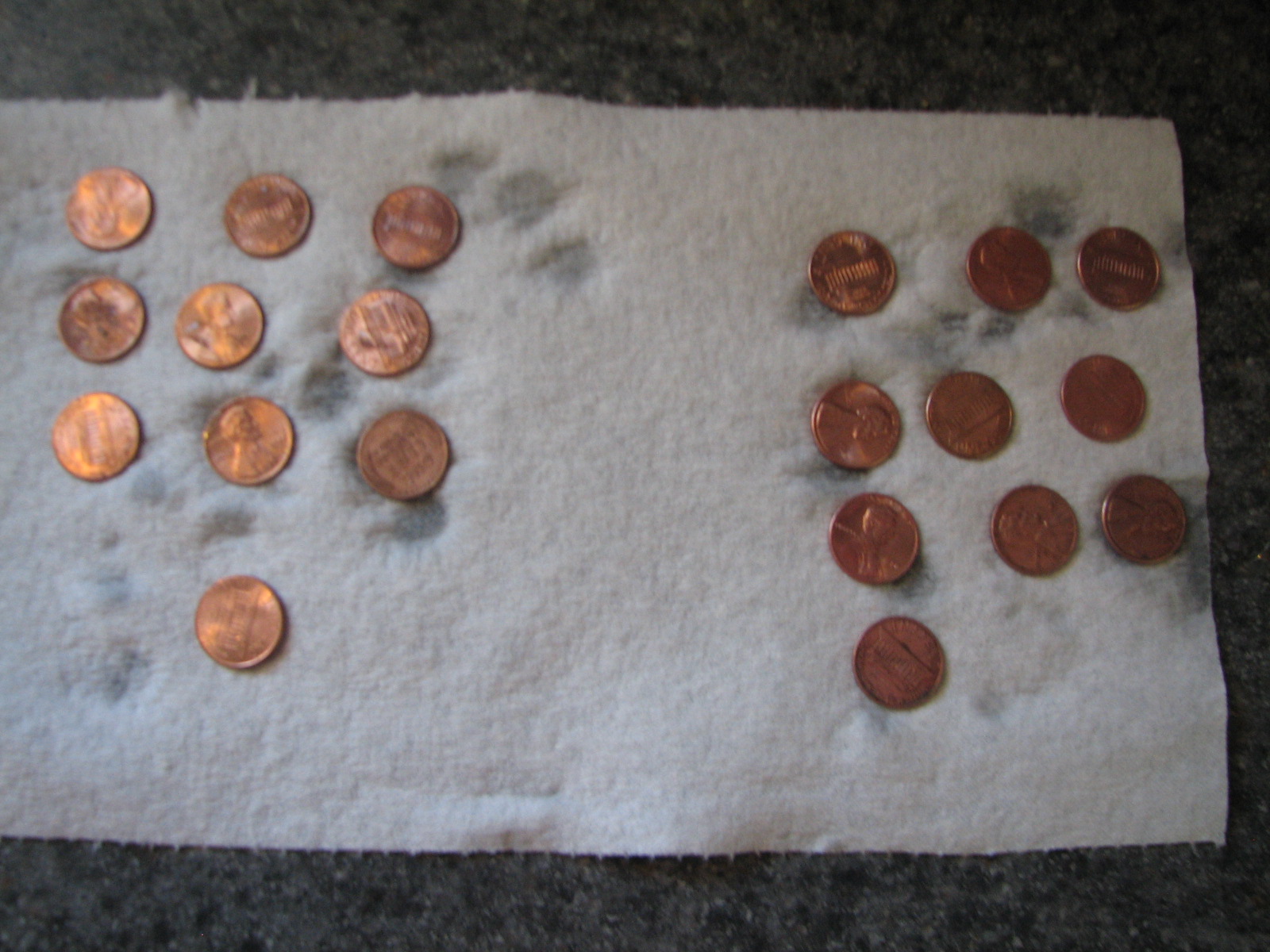
Activity 2: Polish a Penny
Dissolve some salt in a small amount of vinegar.

Place some pennies in the solution, the grungier the pennies, the better!

After a few minutes, remove the pennies and rinse them off.  The pennies should now sparkle brightly!


You can also try dipping half a penny in the solution for a minute or so...


The explanation...
The vinegar/salt solution removed the copper oxide from the pennies, leaving a clean copper surface on each penny.

Over time, all of the pennies will become tarnished with copper oxide once again, as the copper reacts with oxygen in the air.

Tuesday, October 15, 2013

Nursery Rhyme Science: Jack and Jill

Jack and Jill went up the hill,
To fetch a pail of water.
Jack fell down and broke his crown,
And Jill came tumbling after.

Activity 1: Was it more work to go up the hill or down?
Do your students think it would be harder to walk up the hill with an empty bucket or back down the hill with a full bucket?

After students have made their guesses, have them each walk up a set of stairs (or a hill if you happen to have one readily available), carrying an empty milk jug.  Then have them walk down the same stairs with a milk jug that's full of water. 

What do they think now? 


Activity 2: Don't Break Your Crown!
As my son told me, "Crown means head."  And you can use this rhyme to give a quick lesson on the brain.

You'll need a small container (with a tight-fitting lid), 2 eggs and some water.


Throughout the demonstration, the egg yolk will represent your brain and the container will represent your skull.

Crack one egg into the container and put the lid on. 

Agitate the container - you can just shake it, or you can have a student run a few laps around the room with it for it.
Open the container and observe - scrambled brains!
Clean out the container and crack the second egg into the container. 

This time, before putting on the lid, fill the remaining space in the container with water. 

Agitate the container once again.

Open the container and observe - the egg yolk remains intact.  (The egg what froths up a little bit, making it difficult to see at first, but the whole yolk is there).

The water cushions the egg yolk, just as the cerebrospinal fluid cushions your brain. 


Nursery Rhyme Science is a series of short stand-alone activities that can be interjected into a language-intense preschool or kindergarten curriculum with minimum preparation.  Additional Nursery Rhyme Science posts can be found here

Tuesday, October 8, 2013

Nursery Ryme Science: Little Miss Muffet

Little Miss Muffet
Sat on a tuffet,
Eating some curds and whey.

Along came a spider
Who sat down beside her,
And frightened Miss Muffet away.

Activity 1: What are curds and whey?

 Pour a quart of milk into a pot.  Add 6 tablespoons of lemon juice or vinegar.  Slowly heat the pot, while stirring.
 
When the milk begins to curdle (only a minute or two), you can remove it from the heat, but continue to stir and watch.  When you're finished, you'll have curds (the solid part) and whey (the liquid). 

The curds are a very simple cheese and can be eaten if your school allows such things.  (You may wish to refrigerate them and add a pinch of salt).


Activity 2: Why don't spiders stick to their own web?
Spider webs are notoriously sticky - that's how the spiders catch their yummy bug dinners.  But, how can a spider walk across his (or her) own web without getting stuck?


Provide each student with a small strip of scotch tape and have them walk their fingers across the tape.  Then have each student dip his (or her) fingers into a small dish of oil and try walking their fingers across the tape again.  The oil prevents the fingers from sticking.

It's believed that spiders produce a substance that acts like the oil and prevents them from sticking to the web.


Nursery Rhyme Science is a series of short stand-alone activities that can be interjected into a language-intense preschool or kindergarten curriculum with minimum preparation.  Additional Nursery Rhyme Science posts can be found here

Tuesday, October 1, 2013

Nursery Rhyme Science

I've been rolling around ideas for pairing science activities with nursery rhymes for some time now, but had yet to do anything with it.  Part of me was unsure as to the usefulness of such a pairing, since kids' knowledge of nursery rhymes seemed to be a thing of the past. 

And then our second son started kindergarten in this, the age of the common core, and I learned that nursery rhymes are, in fact, part of the kindergarten common core.  (Which I'm loving.... nursery rhymes are the classic literature of kindergarten (and I'm guilty of neglecting to teach them to my own children) and I am enjoying listening to him recite them while walking around the house).

Suddenly my idea for pairing science activities with these rhymes seems very pertinent!  And if I'm too late for this year, it's never to early to start gathering ideas for next year!

These are going to be very simple, stand-alone activities.  The idea is that teachers can implement them in just a few precious minutes, to provide a quick science lesson as well as change the pace of the lesson. 

Most of these activities are simplified versions of more complex activities.  I'll provide links, when possible, to the more advanced activities for those of you who teach older students (so please stick around, even if preschool/kindergarten isn't your area). 

The first pairing will be up later this week.  Please pass the word on to those who may be interested!  Let's get kindergarten teachers excited about including science in their lessons, and in turn, get kindergarten students excited about "doing" science!

Edited to add the picture.